
|
Eager Space | Videos by Alpha | Videos by Date | All Video Text | Support | Community | About |
|---|
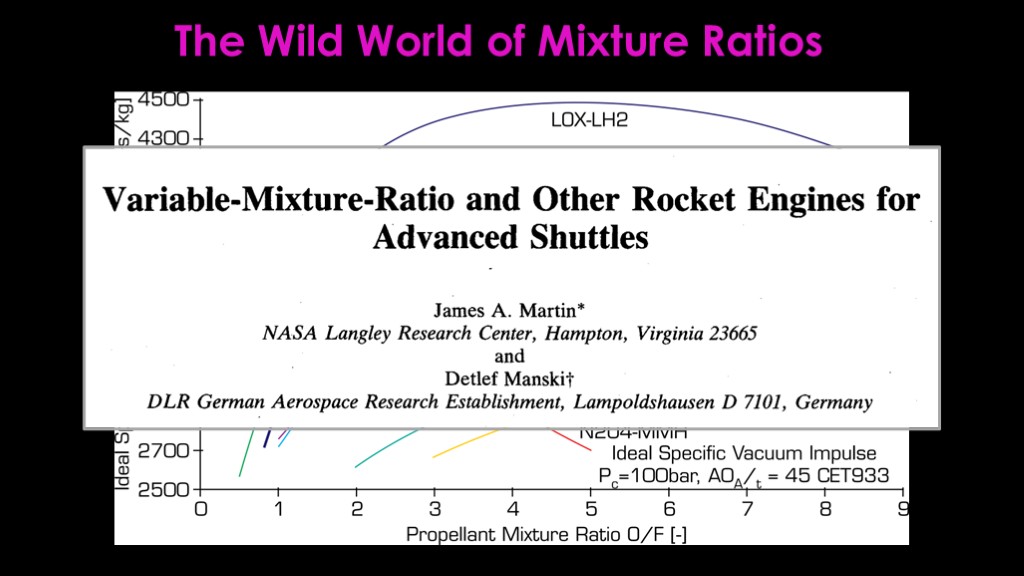
You might have heard about mixture ratios in rocket engines. Maybe you've seen a graph like this one, or come across a paper like this.
It seems like a very complicated topic, but the basics are simple.
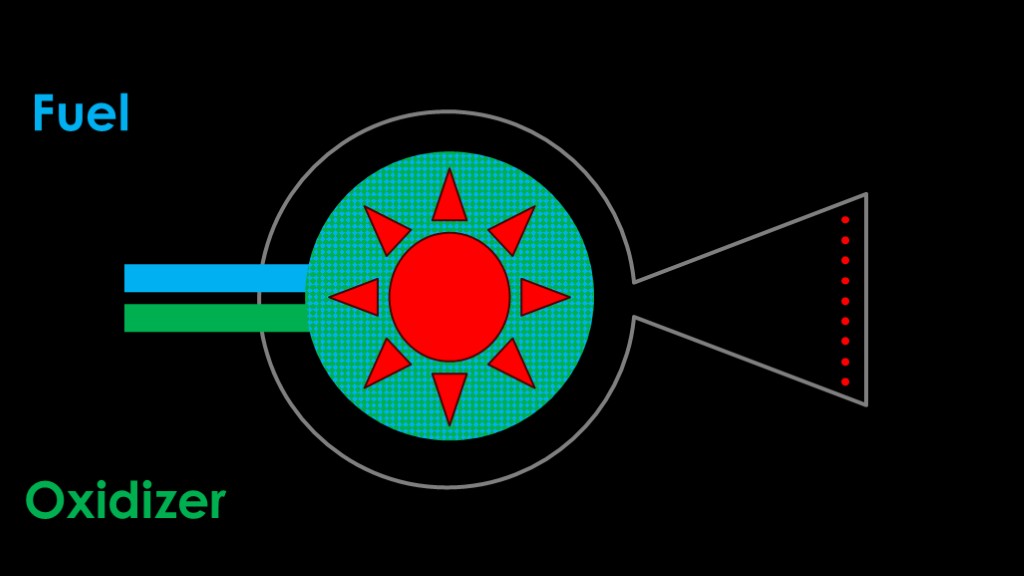
The goal of a rocket engine is to combine fuel and oxidizer in the combustion chamber to burn and to generate high pressure, and then have the resulting high pressure push the combustion products out the nozzle at high speed.
Mixture ratios are about how much fuel and how much oxidizer are fed into the rocket engine.
To understand mixture ratios, we'll need to spend a little time looking at the chemistry of combustion, and we're going to look at hydrolox engines - those that burn liquid hydrogen and liquid oxygen -because they have the simplest chemistry.
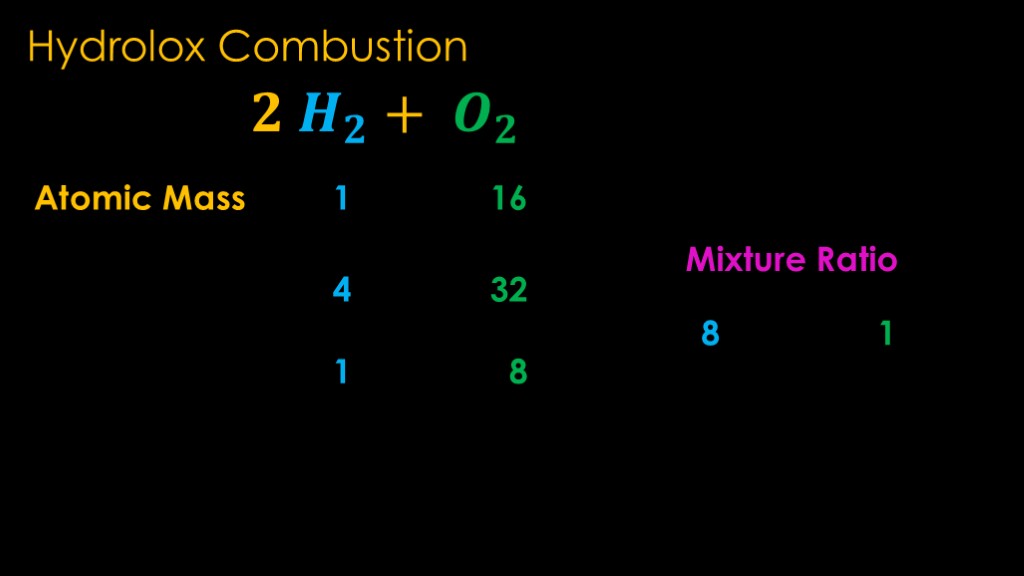
If we were in chemistry class, we'd write the combustion reaction between hydrogen and oxygen as two hydrogen molecules plus one oxygen molecule gives us 2 water molecules.
It also gives us quite a bit of heat.
This is a balanced equation - the amount of mass going in equals the amount of mass coming out.
In rocketry, we usually look at this from the perspective of mass rather than the number of atoms. To convert to mass, we need to know that the atomic mass of hydrogen is pretty close to 1 and the atomic mass of oxygen is pretty close to 16. We multiply that by the number of atoms, and we get 4 for hydrogen and 32 for oxygen, which we will simplify to a ratio of 1 to 8.
In rocketry, we call this the mixture ratio and always write it with the oxygen amount first.
We therefore say that for hydrolox engines, the complete combustion ratio - otherwise known as the stoichiometric ratio if you want to sound all chemistry-ish - is 8 parts oxygen to 1 part hydrogen by mass.
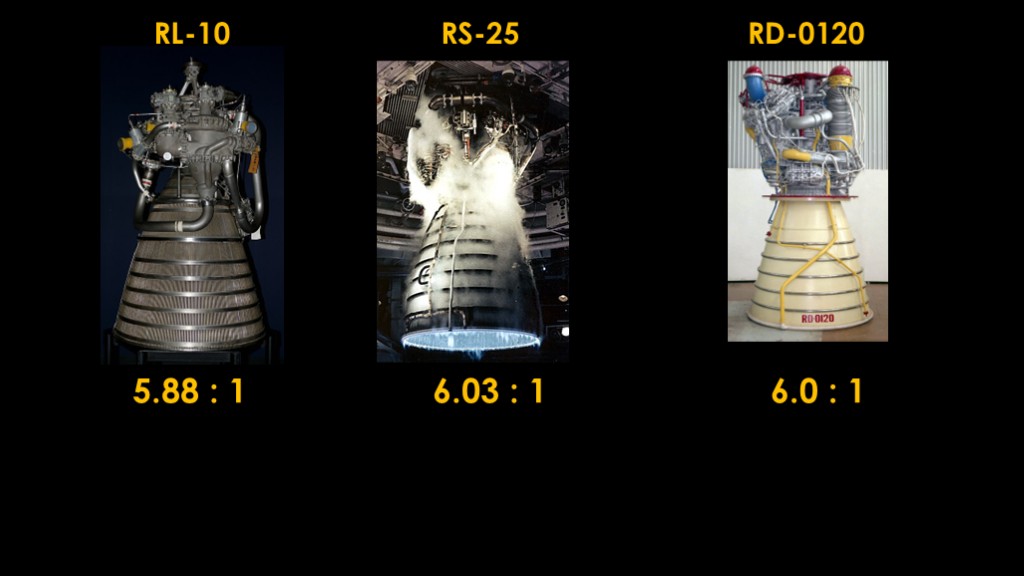
Let's look at some hydrolox engines.
We'll look at the RL-10 used on centaur upper stages, the RS-25 used on the space shuttle and SLS, and the Russian RD-0120 used on their retired energia rocket.
Their mixture ratios are 5.88 to 1, 6.03 to 1, and 6.0 to 1.
None of them are even close to the stoichiometric ratio of 8. They are what we call "fuel rich" - the amount of fuel that is fed into the combustion chamber is more than the amount required for complete combustion.
That means that their exhaust contains both the water we would expect from the combustion reaction plus unburned hydrogen.
What is going on?
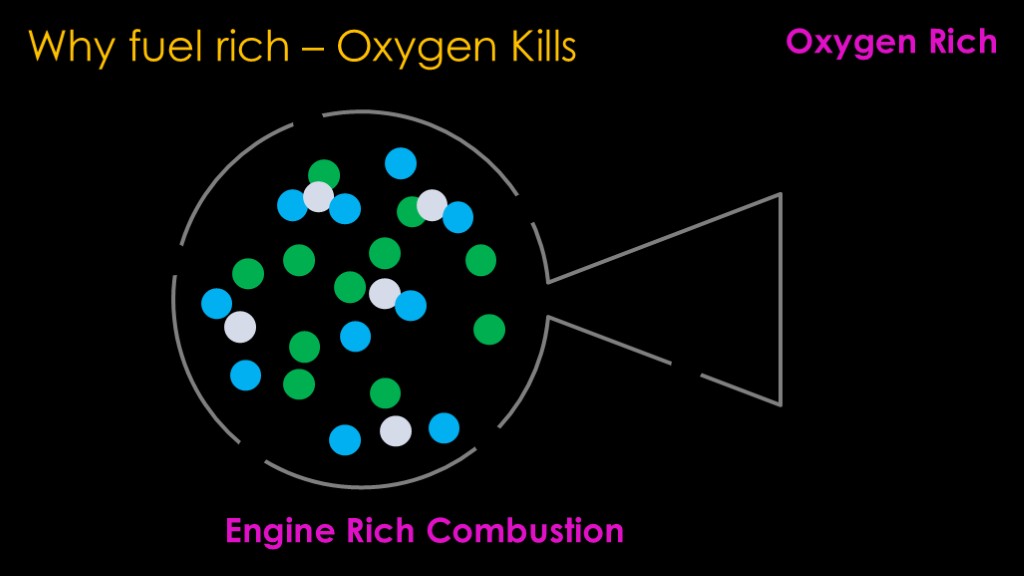
Let's assume we have a hydrolox engine that runs oxygen rich, with more oxygen than we need. Our hydrogen and oxygen will react and create water, and we will have some unreacted oxygen left over. Unreacted oxygen at 3200 kelvin, an extremely high temperature
This very hot oxygen is highly reactive and will eat up your engine. This is sometimes known as "Engine Rich Combustion"
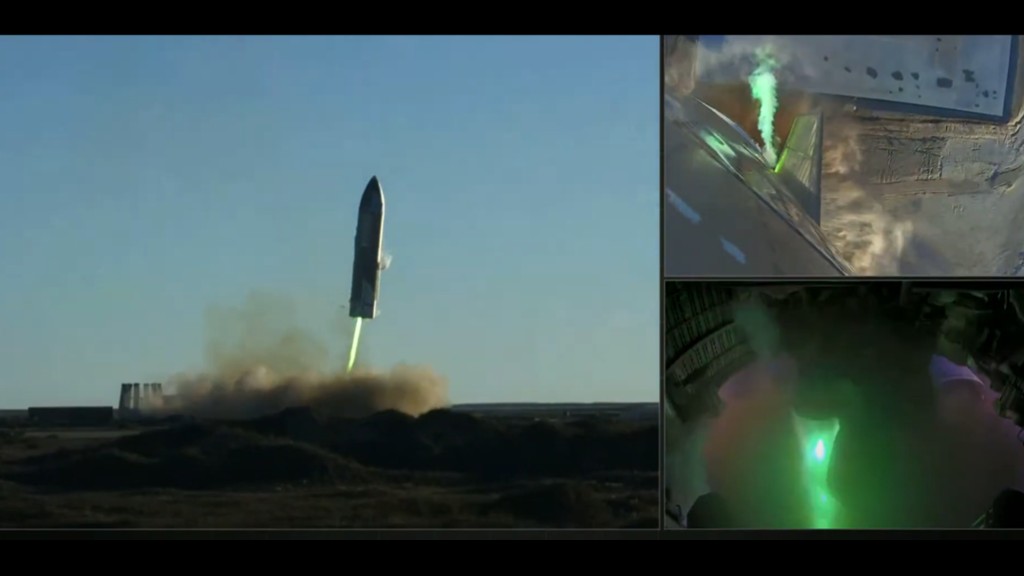
Starship serial number 8 was a great example of this, where a lack of fuel led to an oxygen-rich environment that started combusting the copper lining of the engine and produced a very bright green flame.
This is the main reason engines run fuel rich, and they generally run fuel rich enough so that there aren't any regions of oxygen-rich gas in the engine.
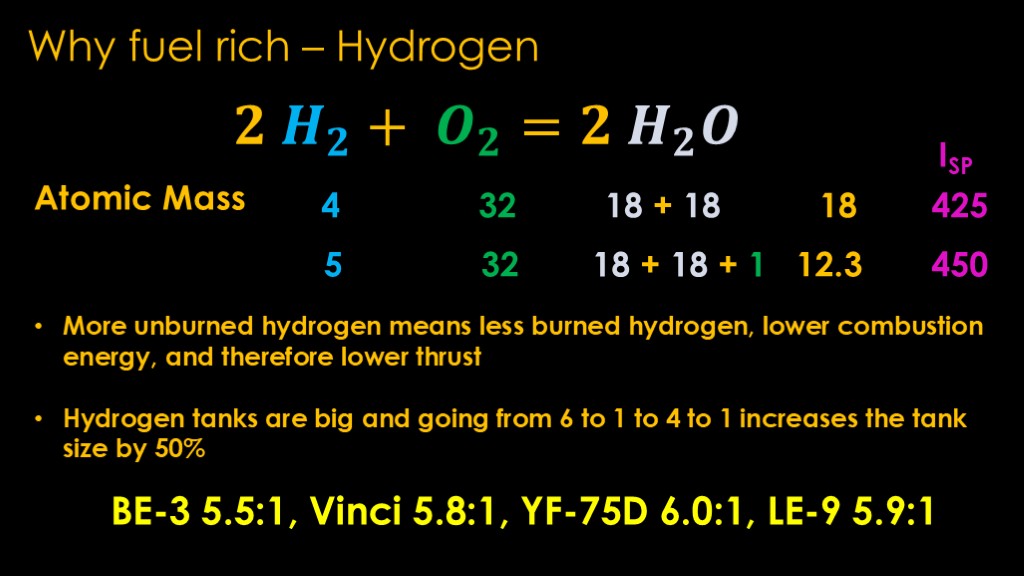
But 6 to 1 is a long way from 8 to 1. Why would a hydrolox engine run so fuel rich?
If we are running a hydrogen engine at the stoichiometric ratio, our exhaust is two water molecules, each of which masses 18, so our exhaust particle mass is very obviously 18.
But if we add 1 extra hydrogen, that extra hydrogen is not burned but comes out of the exhaust stream directly. That drops our average exhaust particle mass down to 12.3 . Lighter particles means higher exhaust speeds, and therefore an increase in the specific impulse - or fuel economy - of the engine.
A hydrolox rocket that runs at an 8:1 ratio might only have a specific impulse of 425, while one that runs at 6 to 1 will end up a little over 450, for a 6% increase.
You can get specific impulse up to about 470 if you drop the mixture ratio down to 4 to 1, but more unburned hydrogen means less burned hydrogen, lower combustion energy, and therefore lower thrust.
Further, hydrogen tanks are big because hydrogen is not dense, and going from 6 to 1 down to 4 to 1 increases the hydrogen tank size by 50%.
This is why hydrolox mixture ratios tend to cluster around 6 to 1.
Blue Origin's BE-3 is 5.5 : 1, France's Vinci is 5.8 : 1, China's YF-75D is 6.0 to 1, and Japan's LE-9 is 5.9 to 1.
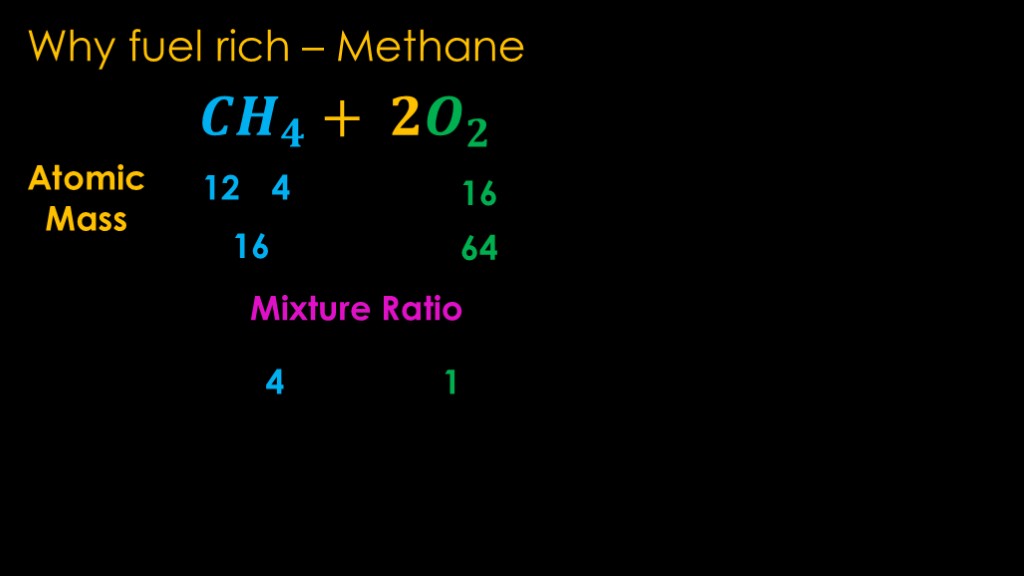
We can do the same analysis with methalox engines, those that burn liquid methane and liquid oxygen.
The combustion is a bit more complex as there are two separate reactions.
The carbon in methane plus one oxygen molecule gives us carbon dioxide, and the 4 hydrogen atoms plus another oxygen molecule give us two water molecules.
Carbon has an atomic mass of 12 and the 4 hydrogens have a mass of 4, so that's 16 for the fuel.
We have 4 oxygen atoms, so that is 64 for the oxygen, and our complete combustion mixture ratio is 4 to 1.
What is our actual combustion mixture ratio?
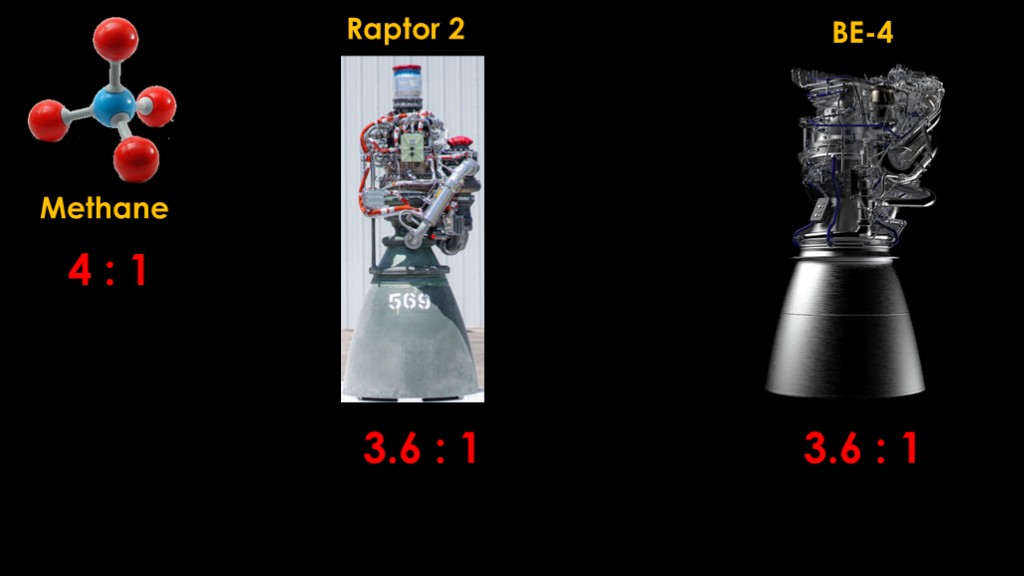
If we look at Raptor from SpaceX and BE-4 from Blue Origin, we find that they both run at about 3.6 to 1, closer to the expected mixture ratio than hydrogen but still more fuel than required for complete combustion.
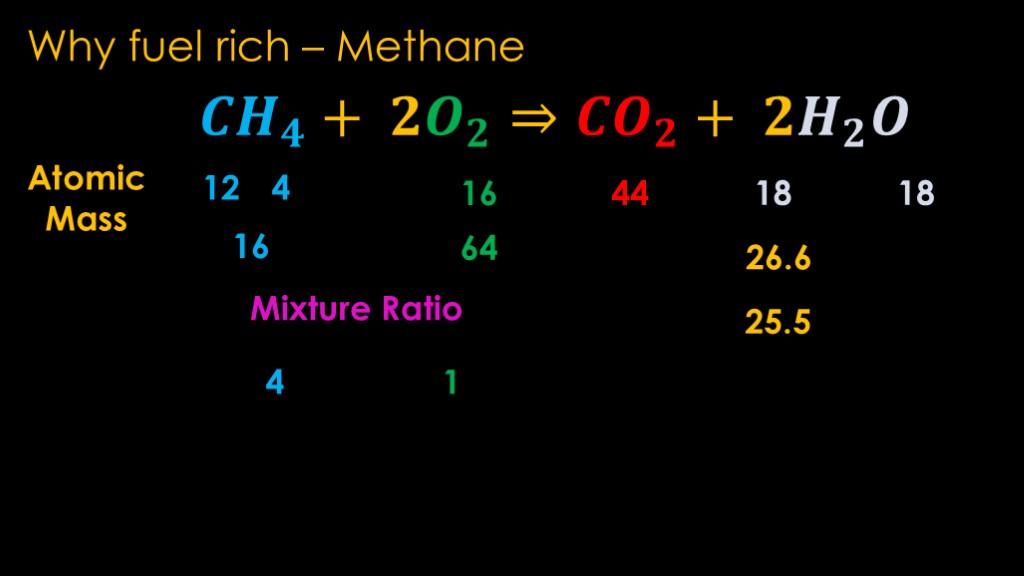
Does running fuel rich increase the specific impulse for methalox?
The carbon dioxide has an atomic mass of 44 and each water molecule has a mass of 18, so the average is 26.6.
That is more than the atomic mass of methane at 16, but it's not the huge difference that hydrogen has.
If we run 10% extra methane, we get a reduction of average atomic mass from 26.6 to 25.5. That's worth about a 0.6% increase in specific impulse. Going to a lower mixture ratio than 3.6 results in both lower thrust and lower specific impulse, so around 3.6 is the general choice.
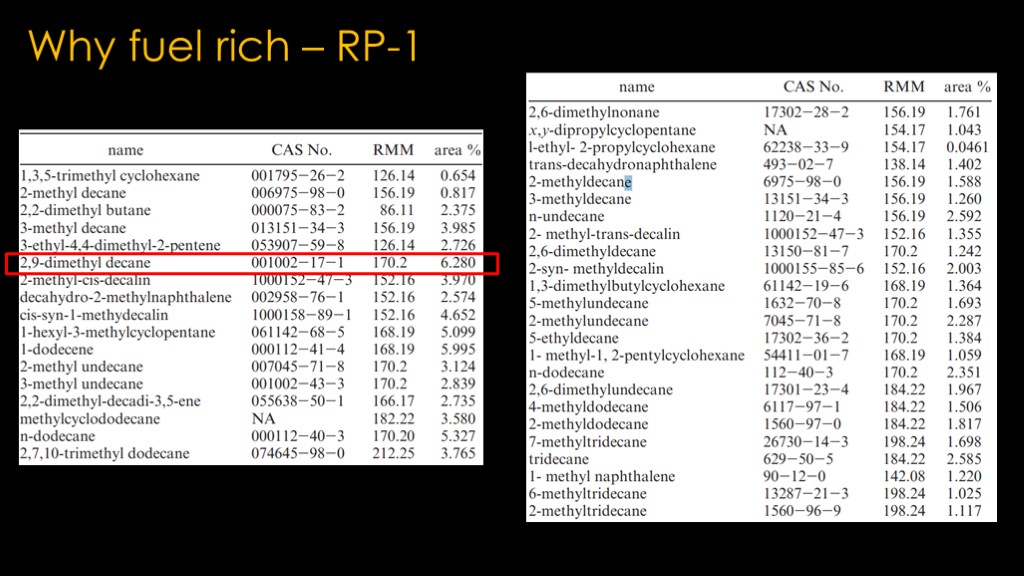
Can we do the same calculations for RP-1?
Here is the chemical composition of two different samples of RP-1 from different suppliers. It's amusing to note that the largest component of the left sample - 2,9-dimethyl decane at 6.3% - doesn't even show up at more than 1% in the right sample. Every one of these components has a different mixture ratio.
This makes it hard to nail down the mixture ratio of engines that use kerosene-based fuels - there are numerous possible formulations that meet the RP-1 spec, and Russian and Chinese formulations are different than US ones.
We do know that the RP-1 formulations tend to have very high average molecular weight, which means letting a lot of fuel escape makes the specific impulse worse.
We would therefore expect them to run closer to the full combustion ratio.
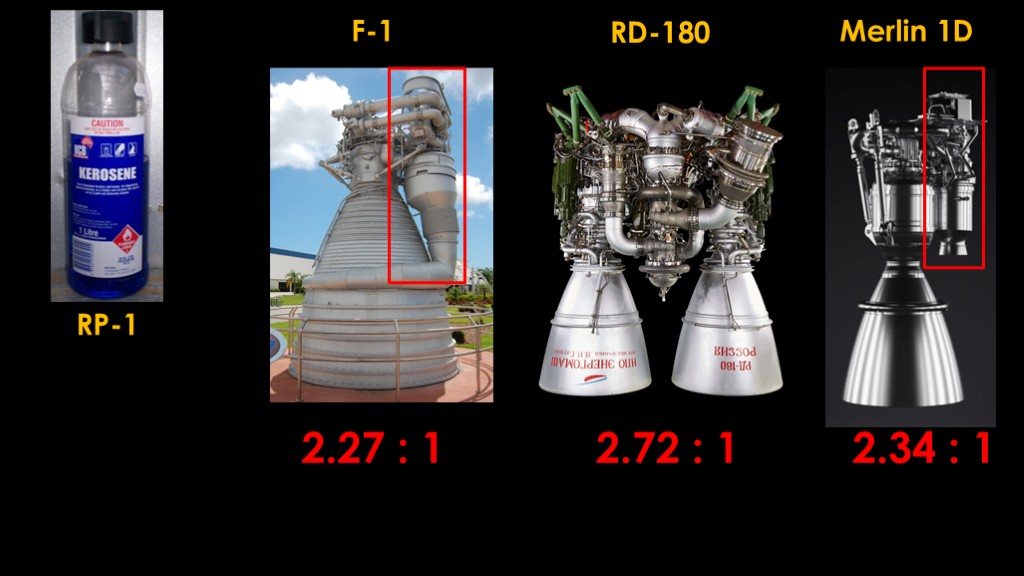
If we look at some RP-1 engines, we see the F-1 engine from the Saturn V first stage ran at 2.27 to 1 and the Merlin 1D on the Falcon 9 runs at 2.34 to 1.
The Russian RD-180 runs at a much higher 2.72 to 1.
What is going on here?
I deliberately picked these engines because both the F-1 and Merlin 1D are gas generator engines. There is a separate combustion chamber that generates gas that drives the turbines that power the propellant turbopumps.
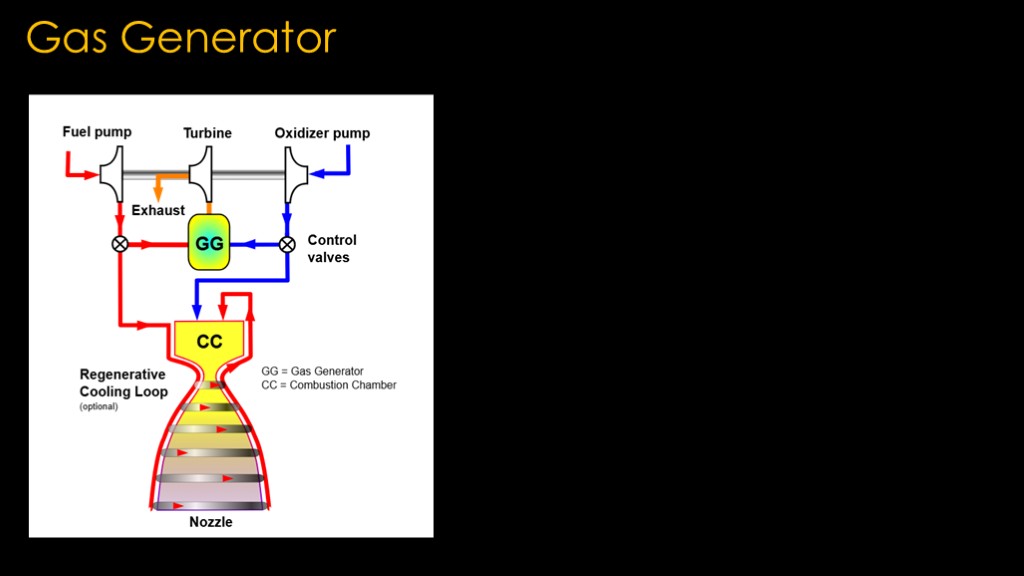
Turbine wheels get melty if the gas you drive them with is too hot, so you need a cooler combustion, and it needs to be quite fuel rich to keep the temperature down. That drives the overall mixture ratio of the engine down.
If we watch this test of the Merlin 1D, we can see the very smoky exhaust from the gas generator.
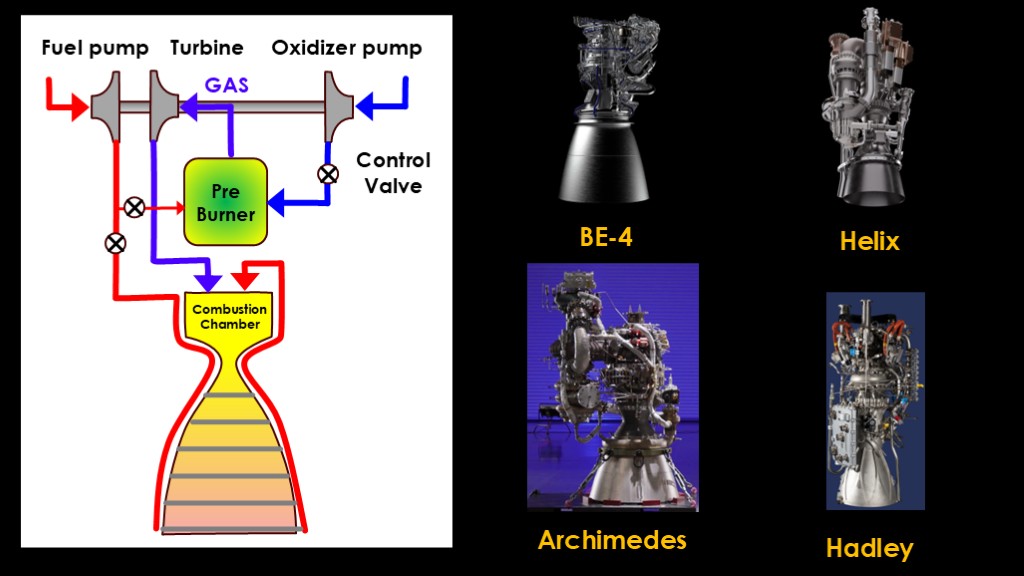
The RD-180 uses the more efficient staged combustion cycle.
The first stage of combustion is done in a preburner. All of the liquid oxygen feeds into the preburner and it is burned with a small amount of fuel. This generates enough heat to convert the liquid oxygen to gas at about 1000 Kelvin. That gas drives the turbine and is then fed into the combustion chamber.
In this approach, there is no gas generator exhaust that is wasted - all the energy in the fuel makes it out through the nozzle. It is not surprisingly considerably more efficient than a gas generator, with a specific impulse improvement of about 10%.
The downside of this approach is that the turbine needs to deal with 1000 kelvin hot oxygen. Not as bad as the 3000 kelvin combustion chamber temp but it's still a lot of heat, and because of that, US engineers believed that building an oxidizer rich staged combustion engine was not practical. The Russians disagreed and developed a series of very good engines.
This engine design is now common. Blue Origin's BE-4 engine powers both New Glenn and Vulcan. Under development are rocket factory Augsburg's Helix, Ursa Major's Hadley, and Rocket Lab's Archimedes.
The fuel-rich preburner approach was used in the RS-25 space shuttle engine and some Russian designs.
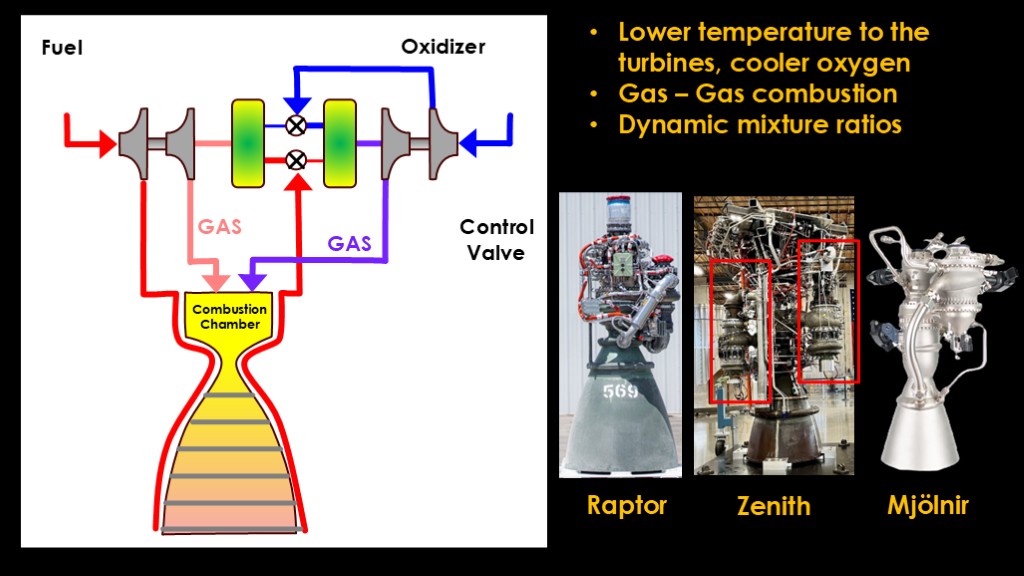
If one preburner is good, why not try two preburners, one where you combust a little fuel with all the oxygen and one where you combust a little oxygen with all the fuel. This can be done if both fuel and propellant are liquids, so hydrolox or methalox engines.
It's known as "full flow staged combustion" because all of the propellant goes through the preburners.
This has a few advantages.
Because you are using two turbines rather than one, each preburner has to do less work and can therefore run at a lower temperature, which means fewer issues with hot oxygen.
The second is that this approach means that both propellants are gas when they enter the combustion chamber - what is known as gas-gas combustion. They mix quicker and more completely which gives more complete combustion and the propellant injectors are easier to design.
The third is that this approach allows you to vary the mixture ratio dynamically as you can control the pumps separately. This is great from a development perspective as you can experiment with mixture ratios using software rather than changing a hardware design. It may also be useful during flight to optimize the mixture ratio for thrust, specific impulse, or other factors.
SpaceX's Raptor is a full flow engine that is currently flying on Starship. Stoke's Zenith engine will fly on their Nova rocket, and you can clearly see the two separate turbopump assemblies. Mjolnir (myol-near) is from New Frontier Aerospace and is intended for hypersonic aircraft, upper stages, and planetary landers.
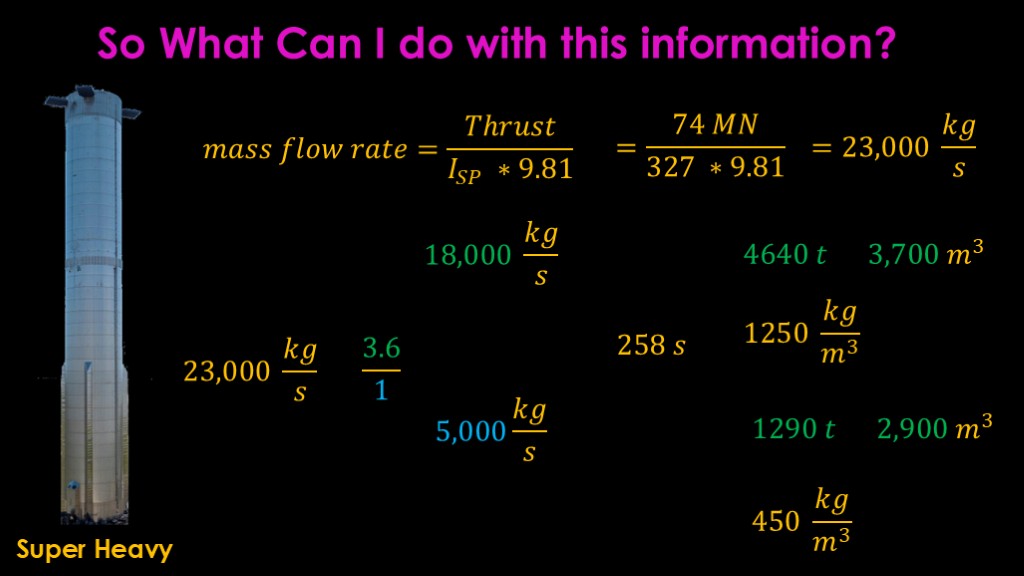
So what can I do with this information?
Let's say you want to know how much propellant super heavy burns before staging...
We know that the mass flow rate - how much propellant the engine burns - is equal to the thrust divided by the specific impulse multiplied by 9.81.
SpaceX says that that block 1 and 2 of super heavy has a thrust of 7590 tons, which is equivalent to 74 meganewtons, and it has a specific impulse of 327.
Plug those numbers in, and we get a mass flow rate of 23,000 kilograms per second. We know the mixture ratio is 3.6 to 1, so we take the 23,000 kilograms and divide it by 4.6 - the sum of both parts of the ratio - and that gives us 18,000 kilograms per second of liquid oxygen and 5000 kilograms per second of liquid methane.
The time before staging on flight 10 was 258 seconds, so that's 4640 tons of liquid oxygen and 1290 tons of liquid methane.
We can figure out how much tank space that requires. You can stuff 1250 kilograms of subchilled liquid oxygen in a cubic meter, and 450 kilograms of subchilled liquid methane in a cubic meter, and little bit of math tells us that is about 3700 cubic meters of liquid oxygen and 2900 cubic meters of liquid methane.
And that's the story with mixture ratios...

If you enjoyed this video, the song of the day is the cars' haunting "All mixed up", the last song on side 2 of their 6x platinum self titled debut album released in 1979.